How to pitch local sponsors using podcast listener geography
Nathaniel DeSantis
Sponsorship & Monetization

Introduction
Here is a secret about podcast listener geography: almost every show, even a mid-size one, has listeners piled up in a handful of metros. That concentration is a sales asset most podcasters never use.
National sponsors want scale you may not have yet. Local sponsors want something you might already own — 800 real listeners in Denver who hear your voice every week. To a Denver bike shop, that is not a small number. That is a room they could never fill.
This post walks through finding your top metros, building the pitch, and pricing a local deal so it works for both sides.
Key takeaway
Most shows have concentrated metros even when total downloads are modest
Local sponsors compare you to local radio and print, not to Joe Rogan
Find your top metros first, then look for businesses that match your content
Pitch the metro number, not the total: “800 listeners in Denver” lands harder than “5,000 worldwide”
Back the claim with a listener map and a CSV, not a promise
Why local beats national for smaller shows
A national media buyer filters by downloads and moves on. A local business owner asks a different question: will people near my store hear this?
Their alternatives are drive-time radio spots, community papers, and boosted Facebook posts. Against that lineup, a host-read ad to a few hundred engaged locals — delivered by someone the audience actually trusts — is a genuinely strong buy.
Step one: find your top metros
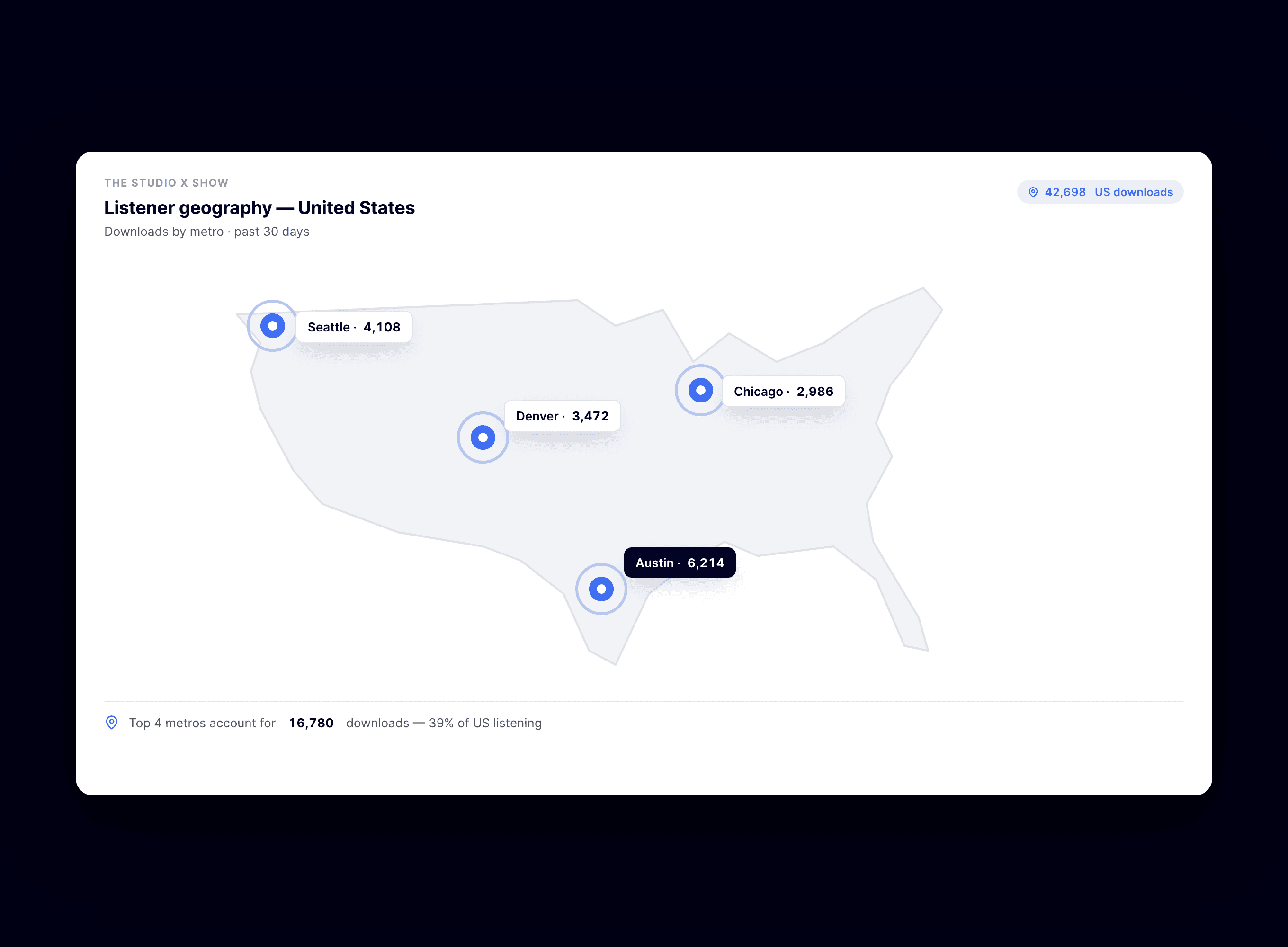
You cannot pitch geography you have not measured. Pull up your analytics and look at downloads by country first, then by US metro area.
In BuzzyPod, the interactive listener map breaks downloads down by country and US metro, so you can see exactly where your audience clusters. Most podcasters are surprised twice: first by how concentrated the top metros are, then by which metros made the list.
Step two: match metros to businesses
Once you know your top three metros, build a short list of businesses in each that fit your content. Fit matters more than size — a hyper-relevant local sponsor converts better and renews longer.
Businesses your show already talks about or around (gear shops for a hobby show, venues for a music show)
Services your listener demographic plausibly buys: gyms, restaurants, realtors, local SaaS
Businesses already advertising locally — they have budget and understand paying for reach
Places you genuinely use, because the host-read will sound real
Step three: build the pitch around the metro number
Lead with their city, not your show. The first line of the pitch is the local stat: “About 800 people in the Denver metro downloaded our last month of episodes.”
Then translate it into their world. Those are locals who chose to listen, hear a trusted voice read the ad, and can act on a promo code the same day.
Open with the metro download number and the map to prove it
One sentence on audience fit — why your listeners match their customers
The offer: format, number of episodes, and a simple flat price
A concrete next step, like a 15-minute call or a one-episode trial
Pricing a local deal
National podcast ads are commonly priced by CPM, typically cited around $15–$30 per thousand downloads for host-read spots. Local deals usually work better as simple flat rates per episode or per month — small businesses think in monthly budgets, not CPMs.
Anchor against what they already spend. If a local radio spot or a month of boosted posts costs them a few hundred dollars, a flat monthly rate for host-read ads to a targeted local audience is easy to justify — and easy to say yes to.
Proof keeps local sponsors around
Local sponsors are often first-time podcast advertisers, so show your work. Send a short monthly note with the episode downloads, the metro breakdown, and any promo code activity they saw on their end.
A clean CSV of daily downloads plus a map screenshot for flavor does more for renewal than any amount of enthusiasm.
Conclusion
You do not need a million downloads to make sponsorship money. You need to know where your listeners are and pitch the businesses standing right next to them.
BuzzyPod’s listener map shows your downloads by country and US metro, backed by OP3’s consistent cross-app counting — so the next time you say “800 listeners in Denver,” you can prove it, for $10 a month.
Related reading
Introduction
Here is a secret about podcast listener geography: almost every show, even a mid-size one, has listeners piled up in a handful of metros. That concentration is a sales asset most podcasters never use.
National sponsors want scale you may not have yet. Local sponsors want something you might already own — 800 real listeners in Denver who hear your voice every week. To a Denver bike shop, that is not a small number. That is a room they could never fill.
This post walks through finding your top metros, building the pitch, and pricing a local deal so it works for both sides.
Key takeaway
Most shows have concentrated metros even when total downloads are modest
Local sponsors compare you to local radio and print, not to Joe Rogan
Find your top metros first, then look for businesses that match your content
Pitch the metro number, not the total: “800 listeners in Denver” lands harder than “5,000 worldwide”
Back the claim with a listener map and a CSV, not a promise
Why local beats national for smaller shows
A national media buyer filters by downloads and moves on. A local business owner asks a different question: will people near my store hear this?
Their alternatives are drive-time radio spots, community papers, and boosted Facebook posts. Against that lineup, a host-read ad to a few hundred engaged locals — delivered by someone the audience actually trusts — is a genuinely strong buy.
Step one: find your top metros
You cannot pitch geography you have not measured. Pull up your analytics and look at downloads by country first, then by US metro area.
In BuzzyPod, the interactive listener map breaks downloads down by country and US metro, so you can see exactly where your audience clusters. Most podcasters are surprised twice: first by how concentrated the top metros are, then by which metros made the list.
Step two: match metros to businesses
Once you know your top three metros, build a short list of businesses in each that fit your content. Fit matters more than size — a hyper-relevant local sponsor converts better and renews longer.
Businesses your show already talks about or around (gear shops for a hobby show, venues for a music show)
Services your listener demographic plausibly buys: gyms, restaurants, realtors, local SaaS
Businesses already advertising locally — they have budget and understand paying for reach
Places you genuinely use, because the host-read will sound real
Step three: build the pitch around the metro number
Lead with their city, not your show. The first line of the pitch is the local stat: “About 800 people in the Denver metro downloaded our last month of episodes.”
Then translate it into their world. Those are locals who chose to listen, hear a trusted voice read the ad, and can act on a promo code the same day.
Open with the metro download number and the map to prove it
One sentence on audience fit — why your listeners match their customers
The offer: format, number of episodes, and a simple flat price
A concrete next step, like a 15-minute call or a one-episode trial
Pricing a local deal
National podcast ads are commonly priced by CPM, typically cited around $15–$30 per thousand downloads for host-read spots. Local deals usually work better as simple flat rates per episode or per month — small businesses think in monthly budgets, not CPMs.
Anchor against what they already spend. If a local radio spot or a month of boosted posts costs them a few hundred dollars, a flat monthly rate for host-read ads to a targeted local audience is easy to justify — and easy to say yes to.
Proof keeps local sponsors around
Local sponsors are often first-time podcast advertisers, so show your work. Send a short monthly note with the episode downloads, the metro breakdown, and any promo code activity they saw on their end.
A clean CSV of daily downloads plus a map screenshot for flavor does more for renewal than any amount of enthusiasm.
Conclusion
You do not need a million downloads to make sponsorship money. You need to know where your listeners are and pitch the businesses standing right next to them.
BuzzyPod’s listener map shows your downloads by country and US metro, backed by OP3’s consistent cross-app counting — so the next time you say “800 listeners in Denver,” you can prove it, for $10 a month.
Related reading
Introduction
Here is a secret about podcast listener geography: almost every show, even a mid-size one, has listeners piled up in a handful of metros. That concentration is a sales asset most podcasters never use.
National sponsors want scale you may not have yet. Local sponsors want something you might already own — 800 real listeners in Denver who hear your voice every week. To a Denver bike shop, that is not a small number. That is a room they could never fill.
This post walks through finding your top metros, building the pitch, and pricing a local deal so it works for both sides.
Key takeaway
Most shows have concentrated metros even when total downloads are modest
Local sponsors compare you to local radio and print, not to Joe Rogan
Find your top metros first, then look for businesses that match your content
Pitch the metro number, not the total: “800 listeners in Denver” lands harder than “5,000 worldwide”
Back the claim with a listener map and a CSV, not a promise
Why local beats national for smaller shows
A national media buyer filters by downloads and moves on. A local business owner asks a different question: will people near my store hear this?
Their alternatives are drive-time radio spots, community papers, and boosted Facebook posts. Against that lineup, a host-read ad to a few hundred engaged locals — delivered by someone the audience actually trusts — is a genuinely strong buy.
Step one: find your top metros
You cannot pitch geography you have not measured. Pull up your analytics and look at downloads by country first, then by US metro area.
In BuzzyPod, the interactive listener map breaks downloads down by country and US metro, so you can see exactly where your audience clusters. Most podcasters are surprised twice: first by how concentrated the top metros are, then by which metros made the list.
Step two: match metros to businesses
Once you know your top three metros, build a short list of businesses in each that fit your content. Fit matters more than size — a hyper-relevant local sponsor converts better and renews longer.
Businesses your show already talks about or around (gear shops for a hobby show, venues for a music show)
Services your listener demographic plausibly buys: gyms, restaurants, realtors, local SaaS
Businesses already advertising locally — they have budget and understand paying for reach
Places you genuinely use, because the host-read will sound real
Step three: build the pitch around the metro number
Lead with their city, not your show. The first line of the pitch is the local stat: “About 800 people in the Denver metro downloaded our last month of episodes.”
Then translate it into their world. Those are locals who chose to listen, hear a trusted voice read the ad, and can act on a promo code the same day.
Open with the metro download number and the map to prove it
One sentence on audience fit — why your listeners match their customers
The offer: format, number of episodes, and a simple flat price
A concrete next step, like a 15-minute call or a one-episode trial
Pricing a local deal
National podcast ads are commonly priced by CPM, typically cited around $15–$30 per thousand downloads for host-read spots. Local deals usually work better as simple flat rates per episode or per month — small businesses think in monthly budgets, not CPMs.
Anchor against what they already spend. If a local radio spot or a month of boosted posts costs them a few hundred dollars, a flat monthly rate for host-read ads to a targeted local audience is easy to justify — and easy to say yes to.
Proof keeps local sponsors around
Local sponsors are often first-time podcast advertisers, so show your work. Send a short monthly note with the episode downloads, the metro breakdown, and any promo code activity they saw on their end.
A clean CSV of daily downloads plus a map screenshot for flavor does more for renewal than any amount of enthusiasm.
Conclusion
You do not need a million downloads to make sponsorship money. You need to know where your listeners are and pitch the businesses standing right next to them.
BuzzyPod’s listener map shows your downloads by country and US metro, backed by OP3’s consistent cross-app counting — so the next time you say “800 listeners in Denver,” you can prove it, for $10 a month.

