Podcast guest consent form: what it covers and when you need one

Nathaniel DeSantis
Release Forms & Legal

Introduction
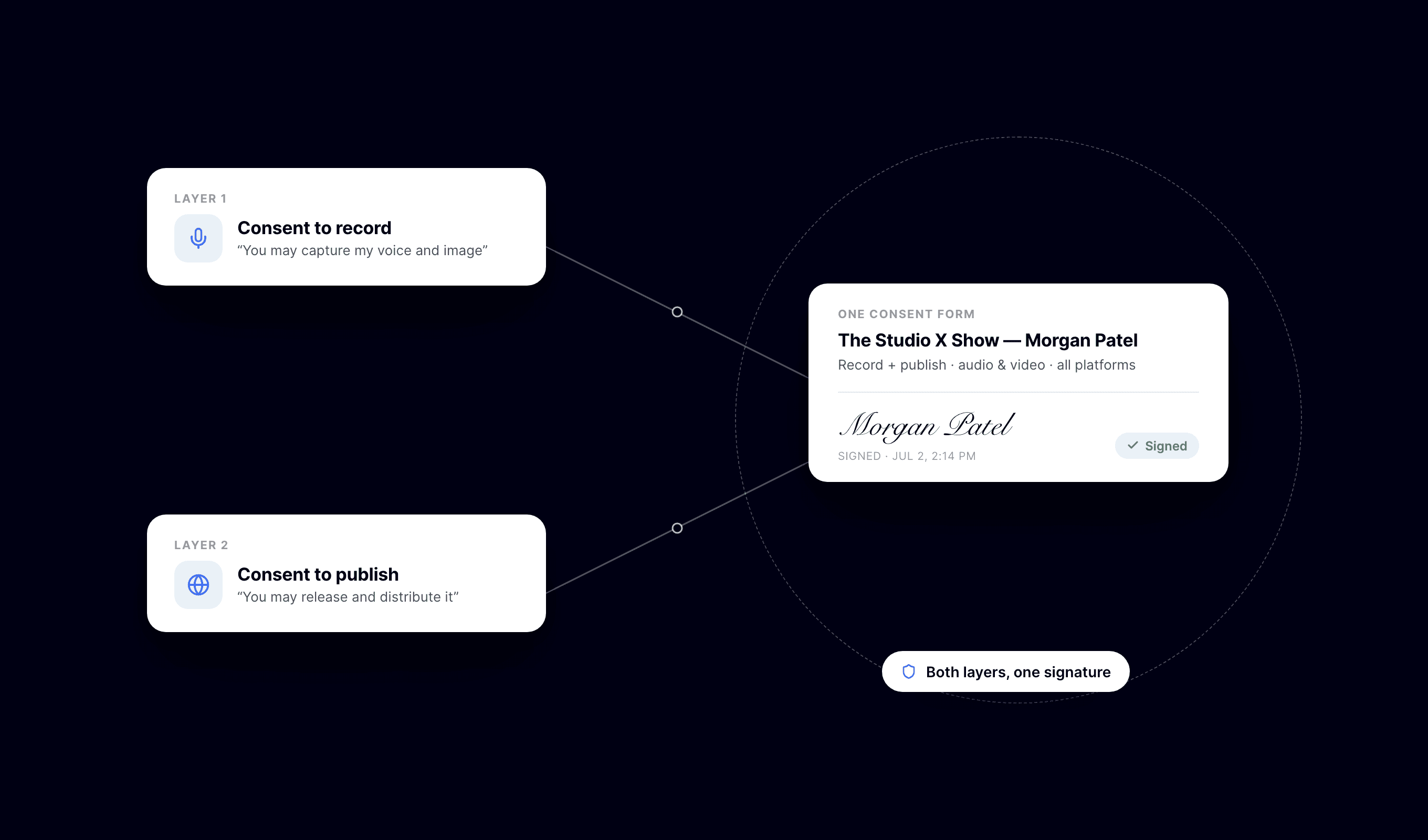
Before any interview episode exists, two permissions have to happen: your guest agrees to be recorded, and they agree to have that recording published. A podcast guest consent form puts both agreements in writing, so neither one rests on assumptions.
You’ll see the terms “consent form” and “release form” used interchangeably, and in practice they’re usually the same document. But thinking about it through the lens of consent — what your guest is agreeing to, stage by stage — is a genuinely useful way to understand what the document does.
This post breaks consent down into its layers and shows when each one matters. Friendly reminder: this is general information, not legal advice — for your specific situation, talk to a lawyer.
Key takeaway
A consent form documents two distinct agreements: consent to record and consent to publish.
Recording consent matters legally — some US states require all parties to consent to being recorded.
Publication consent covers where the recording goes: episodes, clips, promo, any platform.
Consent to editing is its own layer — guests agree the published version won’t be the raw tape.
Written, signed consent turns assumptions into documentation.
Layer one: consent to record
The first permission is the most basic: your guest agrees to be recorded at all. It sounds too obvious to write down — they showed up to a podcast, didn’t they? — but it’s worth documenting anyway.
Recording consent has real legal texture in the US. Some states are one-party consent states (one participant’s consent is enough to record a conversation), while others require all parties to consent. Remote interviews can cross those state lines, which gets murky fast.
A signed consent form cuts through the map entirely: every party has consented, in writing, regardless of which state anyone was sitting in. The strictest standard is met by default.
Layer two: consent to publish
Agreeing to be recorded is not the same as agreeing to be broadcast. Plenty of real disputes live in this gap — a guest who thought a segment was background, off the record, or going to be cut.
Publication consent should be specific about where the recording can go:
The full episode on podcast apps and your website.
Video versions, if your show has them.
Clips and excerpts on social platforms.
Transcripts and quotes.
Promotional material for the episode and the show.
Spelling this out at signing time means your guest’s yes covers your actual publishing workflow — not just the narrow version they might have pictured.
The layer people forget: consent to editing
Between recording and publishing sits editing — and it deserves its own explicit consent. The episode that ships is not the conversation that happened: it’s trimmed, tightened, and sometimes reordered.
A guest who consented to “the interview” could reasonably claim they didn’t consent to your cut of it. Editing consent closes that gap: the guest acknowledges the published version will be edited at your discretion, and that you may choose not to publish at all.
When do you actually need one?
A practical way to decide: the more distance between the recording moment and how the content gets used, the more you need written consent.
Solo show, no guests: nothing to consent to — skip it.
Casual guest chat, published raw, no revenue: low stakes, but written consent is so cheap it’s still worth it.
Edited interviews: get it in writing — editing is where expectations diverge.
Monetized, video, or sponsor-backed shows: non-negotiable; sponsors and platforms expect you to have documented consent.
Sensitive topics: always — a guest discussing health, work, or legal matters deserves clarity, and so do you.
What written consent looks like in practice
The form itself is short: who’s consenting, what they’re consenting to (recording, editing, publication, and promotional use), the no-compensation understanding, a governing state, and signatures from both sides.
The workflow matters as much as the wording. Send the form when you book the guest, let them sign from their phone in under a minute, and make sure both of you automatically keep a copy of the executed document. Consent that’s easy to give is consent that actually gets documented.
Conclusion
A guest consent form is really a stack of small agreements — record me, edit it, publish it, promote it — captured in one signature before the mics go live. Put it in writing and every later question has a calm, documented answer.
If you want that handled without template hunting, BuzzyPod includes a ready-written guest release with e-signing: fill in your guest’s name and email, send the secure link, and both parties get the executed PDF automatically — $10/month, 14-day free trial.
Related reading
Introduction
Before any interview episode exists, two permissions have to happen: your guest agrees to be recorded, and they agree to have that recording published. A podcast guest consent form puts both agreements in writing, so neither one rests on assumptions.
You’ll see the terms “consent form” and “release form” used interchangeably, and in practice they’re usually the same document. But thinking about it through the lens of consent — what your guest is agreeing to, stage by stage — is a genuinely useful way to understand what the document does.
This post breaks consent down into its layers and shows when each one matters. Friendly reminder: this is general information, not legal advice — for your specific situation, talk to a lawyer.
Key takeaway
A consent form documents two distinct agreements: consent to record and consent to publish.
Recording consent matters legally — some US states require all parties to consent to being recorded.
Publication consent covers where the recording goes: episodes, clips, promo, any platform.
Consent to editing is its own layer — guests agree the published version won’t be the raw tape.
Written, signed consent turns assumptions into documentation.
Layer one: consent to record
The first permission is the most basic: your guest agrees to be recorded at all. It sounds too obvious to write down — they showed up to a podcast, didn’t they? — but it’s worth documenting anyway.
Recording consent has real legal texture in the US. Some states are one-party consent states (one participant’s consent is enough to record a conversation), while others require all parties to consent. Remote interviews can cross those state lines, which gets murky fast.
A signed consent form cuts through the map entirely: every party has consented, in writing, regardless of which state anyone was sitting in. The strictest standard is met by default.
Layer two: consent to publish
Agreeing to be recorded is not the same as agreeing to be broadcast. Plenty of real disputes live in this gap — a guest who thought a segment was background, off the record, or going to be cut.
Publication consent should be specific about where the recording can go:
The full episode on podcast apps and your website.
Video versions, if your show has them.
Clips and excerpts on social platforms.
Transcripts and quotes.
Promotional material for the episode and the show.
Spelling this out at signing time means your guest’s yes covers your actual publishing workflow — not just the narrow version they might have pictured.
The layer people forget: consent to editing
Between recording and publishing sits editing — and it deserves its own explicit consent. The episode that ships is not the conversation that happened: it’s trimmed, tightened, and sometimes reordered.
A guest who consented to “the interview” could reasonably claim they didn’t consent to your cut of it. Editing consent closes that gap: the guest acknowledges the published version will be edited at your discretion, and that you may choose not to publish at all.
When do you actually need one?
A practical way to decide: the more distance between the recording moment and how the content gets used, the more you need written consent.
Solo show, no guests: nothing to consent to — skip it.
Casual guest chat, published raw, no revenue: low stakes, but written consent is so cheap it’s still worth it.
Edited interviews: get it in writing — editing is where expectations diverge.
Monetized, video, or sponsor-backed shows: non-negotiable; sponsors and platforms expect you to have documented consent.
Sensitive topics: always — a guest discussing health, work, or legal matters deserves clarity, and so do you.
What written consent looks like in practice
The form itself is short: who’s consenting, what they’re consenting to (recording, editing, publication, and promotional use), the no-compensation understanding, a governing state, and signatures from both sides.
The workflow matters as much as the wording. Send the form when you book the guest, let them sign from their phone in under a minute, and make sure both of you automatically keep a copy of the executed document. Consent that’s easy to give is consent that actually gets documented.
Conclusion
A guest consent form is really a stack of small agreements — record me, edit it, publish it, promote it — captured in one signature before the mics go live. Put it in writing and every later question has a calm, documented answer.
If you want that handled without template hunting, BuzzyPod includes a ready-written guest release with e-signing: fill in your guest’s name and email, send the secure link, and both parties get the executed PDF automatically — $10/month, 14-day free trial.
Related reading
Introduction
Before any interview episode exists, two permissions have to happen: your guest agrees to be recorded, and they agree to have that recording published. A podcast guest consent form puts both agreements in writing, so neither one rests on assumptions.
You’ll see the terms “consent form” and “release form” used interchangeably, and in practice they’re usually the same document. But thinking about it through the lens of consent — what your guest is agreeing to, stage by stage — is a genuinely useful way to understand what the document does.
This post breaks consent down into its layers and shows when each one matters. Friendly reminder: this is general information, not legal advice — for your specific situation, talk to a lawyer.
Key takeaway
A consent form documents two distinct agreements: consent to record and consent to publish.
Recording consent matters legally — some US states require all parties to consent to being recorded.
Publication consent covers where the recording goes: episodes, clips, promo, any platform.
Consent to editing is its own layer — guests agree the published version won’t be the raw tape.
Written, signed consent turns assumptions into documentation.
Layer one: consent to record
The first permission is the most basic: your guest agrees to be recorded at all. It sounds too obvious to write down — they showed up to a podcast, didn’t they? — but it’s worth documenting anyway.
Recording consent has real legal texture in the US. Some states are one-party consent states (one participant’s consent is enough to record a conversation), while others require all parties to consent. Remote interviews can cross those state lines, which gets murky fast.
A signed consent form cuts through the map entirely: every party has consented, in writing, regardless of which state anyone was sitting in. The strictest standard is met by default.
Layer two: consent to publish
Agreeing to be recorded is not the same as agreeing to be broadcast. Plenty of real disputes live in this gap — a guest who thought a segment was background, off the record, or going to be cut.
Publication consent should be specific about where the recording can go:
The full episode on podcast apps and your website.
Video versions, if your show has them.
Clips and excerpts on social platforms.
Transcripts and quotes.
Promotional material for the episode and the show.
Spelling this out at signing time means your guest’s yes covers your actual publishing workflow — not just the narrow version they might have pictured.
The layer people forget: consent to editing
Between recording and publishing sits editing — and it deserves its own explicit consent. The episode that ships is not the conversation that happened: it’s trimmed, tightened, and sometimes reordered.
A guest who consented to “the interview” could reasonably claim they didn’t consent to your cut of it. Editing consent closes that gap: the guest acknowledges the published version will be edited at your discretion, and that you may choose not to publish at all.
When do you actually need one?
A practical way to decide: the more distance between the recording moment and how the content gets used, the more you need written consent.
Solo show, no guests: nothing to consent to — skip it.
Casual guest chat, published raw, no revenue: low stakes, but written consent is so cheap it’s still worth it.
Edited interviews: get it in writing — editing is where expectations diverge.
Monetized, video, or sponsor-backed shows: non-negotiable; sponsors and platforms expect you to have documented consent.
Sensitive topics: always — a guest discussing health, work, or legal matters deserves clarity, and so do you.
What written consent looks like in practice
The form itself is short: who’s consenting, what they’re consenting to (recording, editing, publication, and promotional use), the no-compensation understanding, a governing state, and signatures from both sides.
The workflow matters as much as the wording. Send the form when you book the guest, let them sign from their phone in under a minute, and make sure both of you automatically keep a copy of the executed document. Consent that’s easy to give is consent that actually gets documented.
Conclusion
A guest consent form is really a stack of small agreements — record me, edit it, publish it, promote it — captured in one signature before the mics go live. Put it in writing and every later question has a calm, documented answer.
If you want that handled without template hunting, BuzzyPod includes a ready-written guest release with e-signing: fill in your guest’s name and email, send the secure link, and both parties get the executed PDF automatically — $10/month, 14-day free trial.

